
The Science of Aging Well
You Don't Get to Skip to the Expensive Part
Part 8 of 8 (series finale) in our series on the science of aging well — and what you can actually do about it
Every week for the past two months, someone in this series has asked me some version of the same question, usually near the end of the visit, almost as an afterthought: "But what about the pills? The NAD+ drips, the longevity clinics — is any of that real?"
It's the right question to end on. So let's finally answer it properly.
Across seven weeks, we met David, who believed his father's early heart attack was a genetic sentence until the data showed lifestyle blunts that risk by nearly three times as much as genetics loads it. We met Harold, eighty-two and convinced it was too late, who found nearly seven extra years sitting inside three ordinary habits. We met Ruth, whose stopwatch told us more than a scan could. We met Michael, whose ApoB caught what his cholesterol panel missed. We met Elena, who learned that sleep isn't a lifestyle extra but the nightly shift your brain uses to clean house. (Every composite patient in this series, including in this closing piece, is drawn from patterns seen often in practice — not specific individuals.)
None of them asked me about senolytics during their first visit. By the time they were ready to, they'd already done the part that actually moves the needle. That order matters more than almost anything else I can tell you in this final piece.
The Cabinet Everyone Wants to Open First Walk into any wellness store or scroll social media for five minutes and you'll be sold NAD+ boosters, "age-reversing" peptides, and biological clock tests, often before anyone has asked whether your blood pressure is controlled. The commercial longevity industry has sprinted far ahead of the clinical evidence, and it's worth being honest about where that evidence actually stands, drug by drug.
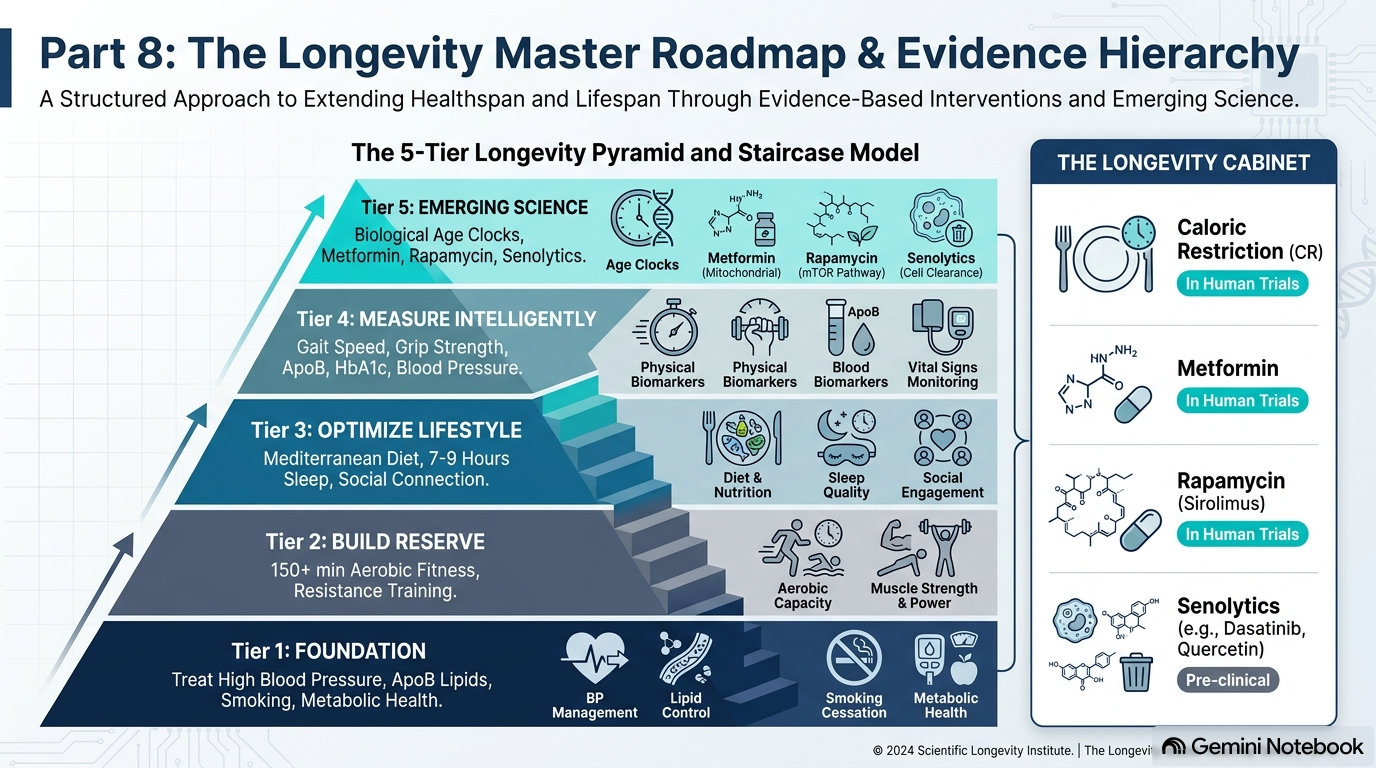
Caloric restriction has the longest track record. The CALERIE trial, the most rigorous human study of sustained calorie reduction to date, put healthy adults through two years of roughly 12% caloric restriction and found a real, measurable effect: about a two-to-three percent slowing of DunedinPACE, an epigenetic clock that tracks the pace of biological aging in real time rather than just providing a snapshot of it. That's a genuine finding, not hype. It's also a modest one, and sustained calorie restriction in older adults carries a real risk of the exact muscle and bone loss that undoes the functional reserve we spent weeks four and five building. This is not a strategy to adopt without real supervision, especially later in life.
Metformin is the drug most people have actually heard of in this context, largely because of the Targeting Aging with Metformin trial — TAME — designed to test whether a single inexpensive drug could delay the onset of multiple age-related diseases at once. It's a genuinely elegant hypothesis. It's also, as of this year, a trial that still hasn't secured full funding or enrolled a single patient, years after it was first proposed. That gap between an exciting idea and an actually completed trial is worth sitting with the next time a headline tells you metformin is "the closest thing to an anti-aging pill."
Rapamycin inhibits a nutrient-sensing pathway called mTOR and reliably extends lifespan in laboratory mice — one of the most repeated findings in aging biology. Reliably extending mouse lifespan and safely extending human healthspan are two different claims, though, and optimal human dosing, long-term immune effects, and real safety data in healthy adults remain genuinely unresolved.
Senolytics — drugs designed to selectively clear the "zombie" senescent cells we described back in week two — have the most direct human data of the group so far, and it's still early. A small 2019 trial combining dasatinib and quercetin in patients with diabetic kidney disease showed the drugs could measurably reduce senescent cell markers in humans, not just mice. That's a meaningful first step. It is not yet a treatment ready for a healthy sixty-year-old.
None of this means the science is fake. It means it's young, and young science sold as a finished product is exactly how good ideas get oversold before they're ready.
The Order That Actually Works Here's the mental model I actually use with patients, and it's simpler than the marketing makes it look. Picture a staircase, not a menu. You climb it in order, and you don't get to skip a step because the one above it is more exciting.
1. The floor: stop the active harm. Controlled blood pressure, a healthy ApoB, no smoking, and
metabolic dysfunction addressed. This is David and Michael's floor, and nothing above it works well
until it's solid.
2. Step one: build physiological reserve. Aerobic fitness, strength, and the functional numbers that
show it — gait speed and grip strength — are the same ones that told Ruth's story better than any
scan.
3. Step two: the daily lifestyle layer. A Mediterranean eating pattern, seven to nine hours of sleep, and
relationships you protect on purpose. This is what Harold's and Elena's stories were built on.
4. Step three: measure intelligently. Track the same handful of numbers we've named throughout this
series, annually, so you always know which step you're actually standing on.
5. The top step: the experimental tier. Rapamycin, senolytics, biological age testing, and whatever the
next headline promises. It makes sense to even discuss this step only once every step below it is solid.
The honest reason most people never benefit from that top tier isn't that the science doesn't work yet. It's that almost nobody has actually finished the tiers underneath it. The industry wants to sell you the staircase's top step. Almost none of your risk is sitting up there.
The Bottom Line Longevity was never going to be about outrunning aging with a molecule discovered last year. It's about compressing morbidity — pushing decline as close to the end of life as it can go — and every genuinely proven way to do that so far has come from the boring floor of that staircase, not its expensive top.
So here's what I want you to do with this entire series, now that it's finished: don't start with the tier five headline that brought you to this article in the first place. Go back to whichever earlier piece in this series matched a number you don't currently know — your ApoB, your gait speed, your actual hours of sleep — and get that number first. The experimental science will still be there, further along, by the time you've actually earned the right to care about it.
Thank you for reading this series from the first week to the last. Your body has been keeping score this whole time. Now you know how to read it.
This article is for education and does not replace individualized medical care. All composite patients referenced across this series, including in this closing piece, are drawn from patterns seen often in practice; their names and details are fictional and do not describe any specific individual.
This series drew on research summarized across all eight parts, including "Hallmarks of Aging: An Expanding Universe" (López-Otín et al., Cell, 2023), "Genetic Predisposition, Modifiable Lifestyles, and Their Joint Effects on Human Lifespan" (Bian et al., BMJ Evidence-Based Medicine, 2024), "Gait Speed and Survival in Older Adults" (Studenski et al., JAMA, 2011), "Effect of Long-Term Caloric Restriction on DNA Methylation Measures of Biological Aging in Healthy Adults From the CALERIE Trial" (Waziry et al., Nature Aging, 2023), public reporting on the Targeting Aging with Metformin (TAME) trial's funding and enrollment status as of 2026 (American Federation for Aging Research), and "Senolytics Decrease Senescent Cells in Humans: Preliminary Report From a Clinical Trial of Dasatinib Plus Quercetin in Individuals With Diabetic Kidney Disease" (Hickson et al., EBioMedicine, 2019). It is meant to inform a conversation with your own doctor, not replace one.