
The Science of Aging Well· Part 7 of 8 — all parts ↓
The Best Thing You Can Do for Your Brain Happens with Your Eyes Closed
Part 7 of 8 in our series on the science of aging well — and what you can actually do about it

We’ve spent six weeks talking about arteries, muscle, and bloodwork. It’s time to talk about the organ running the whole operation — and the one thing it needs that no supplement can replace.
Elena is sixty-four and walked into my office with a small leather notebook, the kind you’d expect to hold a diary, not evidence. Inside, she’d logged every minor memory lapse from the past three months: misplaced keys, twice; a colleague’s name that wouldn’t surface at a dinner party; a few seconds lost hunting for an ordinary word at book club. (Elena, like the composite patients earlier in this series, is drawn from patterns seen often in clinic — not one specific person.) “My mother had Alzheimer’s in her late seventies,” she told me, her voice tight. “I exercise four days a week. I eat well. But every time I blank on a word, I wonder if this is how it starts.”
When I asked about her routine instead of her symptoms, the real story surfaced. Her diet and exercise were, in fact, excellent — genuinely some of the best habits I’d seen from a patient in this series. Her sleep was another matter entirely. A retired high school administrator, Elena had spent thirty years running on other people’s schedules, and retirement hadn’t fixed her relationship with a clock — it had just removed the one that used to force her to bed. She was averaging five to five-and-a-half fragmented hours most nights, scrolling on a tablet well past midnight, and living with a baseline she described, almost proudly, as “constantly wired.”
Elena had come in hoping for a scan or a supplement. What she actually needed was already sitting in her own bedroom, unused.
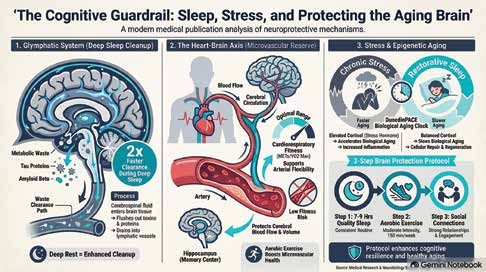
For most of medical history, sleep was treated as a passive shutdown — the brain idling until morning. We now know the opposite is true. During deep, slow-wave sleep, a vascular waste-clearance network called the glymphatic system switches on, and cerebrospinal fluid washes through brain tissue clearing out the metabolic debris that accumulated all day — including tau and beta-amyloid, the same misfolded proteins implicated in Alzheimer’s disease. A landmark 2013 study in Science was the first to show this clearance happens dramatically faster during sleep than wakefulness, in some measures nearly doubling.
Cut sleep below seven hours on a regular basis, and that overnight cleanup gets cut short. The debris doesn’t just sit there harmlessly until the next good night’s rest — over time, it promotes local inflammation and interferes with the connections between neurons that memory itself depends on. This is the same mechanism behind the nearly extra decade of health span found in the study stacking sleep, movement and diet together.
Sleep wasn’t one input among three. For the brain specifically, it may be the one doing the most overnight work.
It’s tempting to think of brain aging as its own separate story from everything else in this series. It isn’t. The brain consumes roughly a fifth of your body’s oxygen and energy despite being a fraction of its mass, which makes it exquisitely dependent on exact vascular health. Reduced blood flow, arterial stiffness, and the kind of small vascular damage that ApoB and unmanaged blood pressure cause over decades don’t spare the hippocampus and prefrontal cortex — the regions responsible for memory and focus. A review from the American College of Cardiology on cognitive impairment in cardiovascular disease makes the connection explicit: microvascular health is a direct determinant of how well the brain ages, not a separate concern from it.
That’s also why the cardiorespiratory fitness data from earlier in this series does double duty. Every one-MET increase in exercise capacity — the same measure behind that 15% mortality reduction we discussed with Harold — also boosts nitric oxide production in the vessel lining, keeping the brain’s smallest blood vessels flexible enough to keep delivering oxygen to its hungriest regions as they age.
The third piece is one we hadn’t yet discussed directly: chronic stress. Sustained elevated cortisol interferes with the hippocampus’s ability to generate new neurons and can compromise the blood-brain barrier itself — mechanisms distinct from sleep loss, but ones that feed into the same inflammatory network we described back in week two. Newer epigenetic clocks that track the pace of biological aging in real time, rather than a snapshot of it, have found that chronic stress and poor sleep measurably speed that clock up. Elena’s “wired” feeling wasn’t just uncomfortable. It was doing something.
I didn’t order Elena a scan. I gave her three changes, none of them expensive. A real sleep window. A 9:30 p.m. digital curfew, no screens in the bedroom, and a fixed wake time —the fastest lever available for protecting nightly glymphatic clearance.
The exercise she already had, tuned slightly. Same routine, with brief higher-intensity intervals added to support the blood flow her brain depends on.
The social piece from week four, taken more seriously. Her book club became a standing weekly commitment rather than a maybe. It’s the same protective effect on inflammation we discussed with Harold’s card game, but the number behind it deserves repeating here: a meta-analysis of over 300,000 people found that strong social relationships predict a 50% greater likelihood of survival — a bigger swing than quitting smoking produces in most models. Aimed at a brain instead of a heart, that same connection builds cognitive reserve against dementia while dampening the same inflammation driving Elena’s fatigue.
Elena came back four months later sleeping seven and a half hours most nights. Her word-finding had returned. The notebook, she told me, had gone unused for weeks — not because she stopped caring, but because she stopped needing it.
So here’s what I want you to do tonight, regardless of your age: pick a wake time and hold it for two weeks, even on weekends. Move your phone charger outside the bedroom. That’s it — that’s the whole intervention to start. The brain has been running its own maintenance shift for as long as humans have slept. Most of us have simply stopped giving it the shift to work.