Where Del Norte’s police calls happen: a map of four months of calls for service
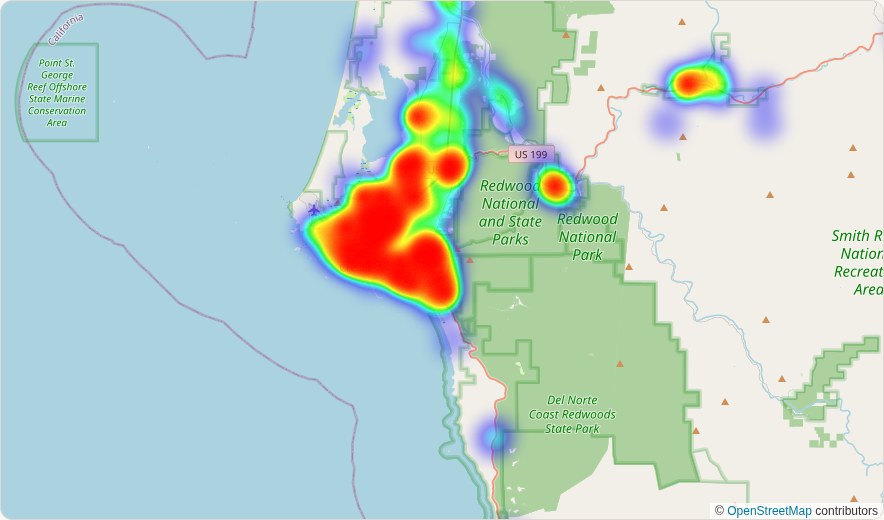
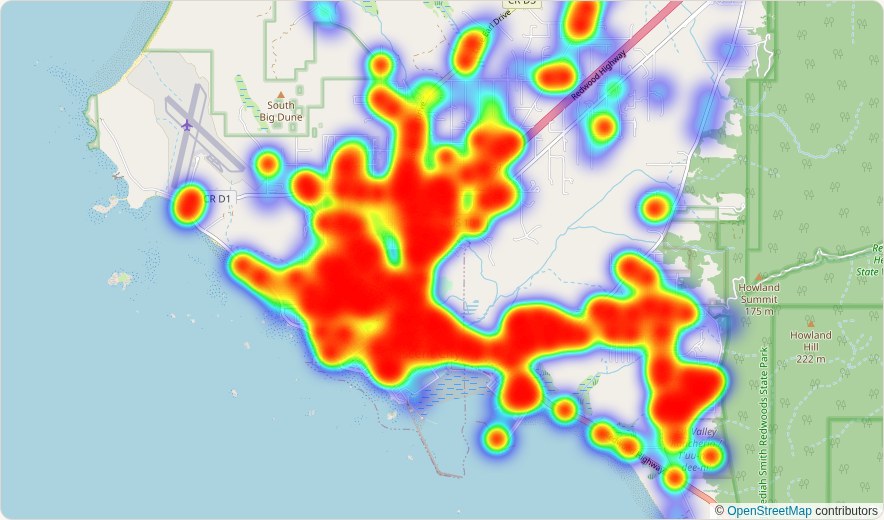
In the four months since the Triplicate began tracking the public police call log published through CitizenRIMS, dispatchers have logged 1,271 calls for service with a mapped location — about 10 a day between June 11 and Oct. 9.
The log covers calls for service handled by both the Del Norte County Sheriff’s Office and the Crescent City Police Department.
Plotted on a map, those calls follow a clear pattern. They cluster in and around Crescent City, along Northcrest Drive and East Washington Boulevard, and up and down U.S. Highway 101.
The Crescent City area accounted for 1,018 of the calls, or 80%. Smith River had 118, Fort Dick 35, Klamath 28, Gasquet 21 and Hiouchi 16.
Northcrest Drive had more calls than any other street, with 113, followed by East Washington Boulevard with 93. Next were Highway 101 South with 47, and Elk Valley Road and Highway 101 North in Crescent City with 45 each.
Disturbances made up the largest share of calls, 568 or 45%. The log uses that category broadly: it includes disturbance calls, suspicious circumstances, requests to remove someone and reports of possible gunshots, fireworks or explosions.
Traffic incidents accounted for 340 calls, or 27%, most of them traffic stops (148) and pedestrian checks (87). Property crimes made up 201 calls, led by theft (118), trespassing (47) and vandalism (33).
The log’s “crimes against person” category had 162 calls, including assaults (45), threats (40) and harassment (28). The log also files burglaries (30) and fraud (19) under that category.
Calls peaked in the evening. The busiest hours were 8 p.m., with 87 calls, and 10 p.m., with 85, followed by 11 p.m. The quietest stretch was between 4 and 6 a.m. Fridays were the busiest day of the week, with 213 calls.
Most calls ended without a report or arrest. The log lists 323 as documentation only, 174 as checks OK and 126 as ending in a warning. An arrest was made in 69 calls, and a report was taken in 66.
The call log records calls for service — reports from the public and stops initiated by officers — not confirmed crimes, and the information is preliminary and subject to change. Locations are published at the block level.
Readers can explore the data on the Triplicate’s new Crime Map at triplicate.com/public-safety/map, filtering by type of call, area and date. The map updates every 15 minutes as new calls come in, and it also includes earlier calls from the police blotters the Triplicate has published since 2019.