
The Harbor District: Kneeling Before Collapse
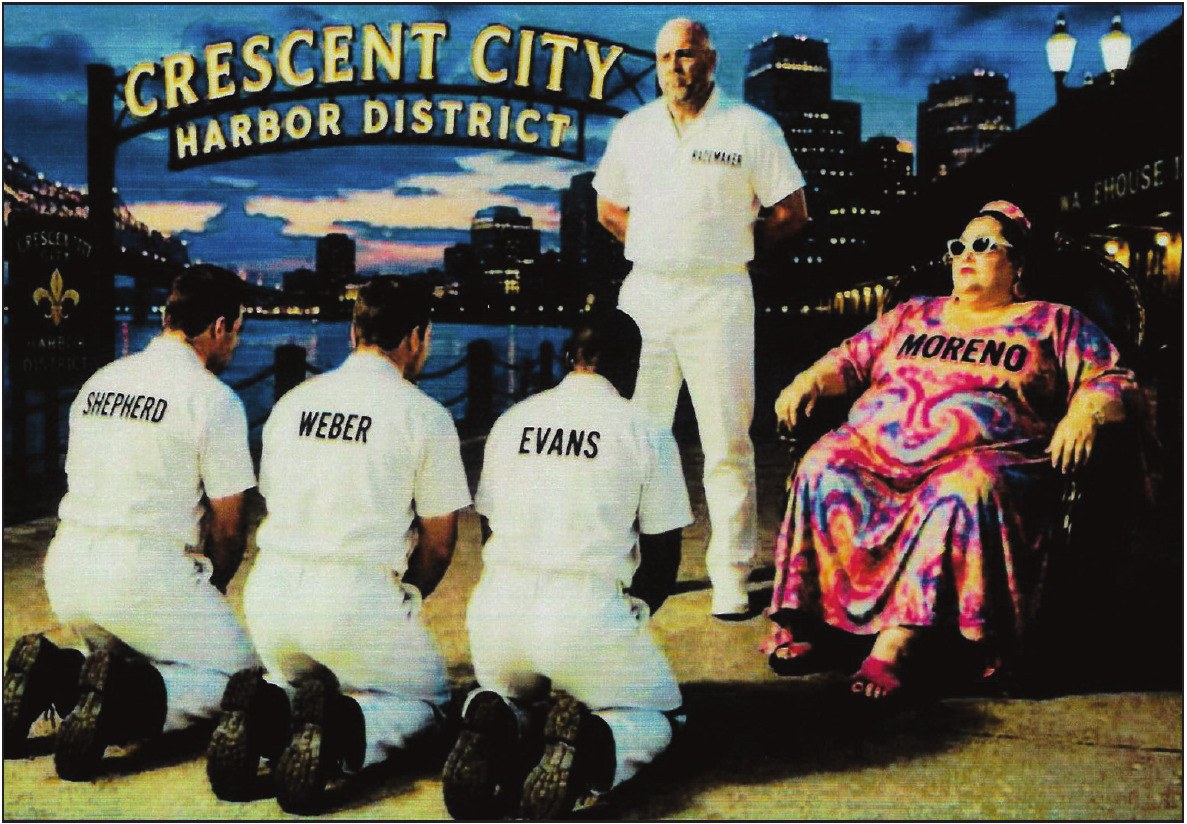

At the edge of the Pacific, where fishing boats once symbolized survival, grit, and honest labor, the Crescent City Harbor had become something else entirely — a stage where power, loyalty, and financial chaos performed in plain view before the public.
The image tells the story without apology.
Three Harbor Commissioners — Rick Shepherd, Gerhard Weber, and John Evans — are depicted on their knees wearing kneepads before Harbormaster Mike Rademaker and his right-hand financial operator Sandy Moreno. It is symbolic, not of service to the taxpayers, but of submission. Submission to a management structure that critics say has driven the harbor into financial instability while demanding absolute loyalty from the board majority.
In this version of the harbor, the kneepads are not about humility. They represent surrender. Surrender of oversight. Surrender of accountability. Surrender of independent judgment.
While fishermen struggle, infrastructure decays, audits remain unfinished, and USDA loan obligations spiral into crisis, the board majority appears less interested in asking hard questions than in protecting the very people steering the ship into dangerous waters.
The public watches meeting after meeting unfold like financial theater. Words such as “cash flow,” “reserve restructuring,” and “turnaround plan” are repeated over and over, while basic realities remain unavoidable: the Harbor District failed to make its USDA payment on time, incurred additional interest, lacks completed audits, and still struggles to produce a finalized Harbor Facilities Plan necessary to unlock Measure C TOT funds.
Yet instead of accountability, critics see rationalization. Instead of answers, they hear confusion. Instead of transparency, they hear constant references to verbal conversations, Zoom meetings, undocumented understandings, and shifting explanations.
Commissioner Annie Nehmer repeatedly questioned why payments were delayed, why extra taxpayer interest was incurred, and why essential documents and planning remained incomplete. Her concerns were often met not with clarity, but with defensiveness and hostility.
The symbolism of the painting grows darker when viewed against the harbor’s financial backdrop.
A harbor once entrusted with public money now speaks openly of borrowing against reserves, restructuring debt, delaying obligations, and hoping future cash flow somehow fixes present failures. The same officials defending these strategies simultaneously admit they need more money, more staff, more time, and more patience from the public.
And still, the kneeling continues.
The image portrays Moreno seated beside Rademaker like a royal adviser whispering financial doctrine into the ears of obedient commissioners. Around them, the harbor itself appears to rot — docks splintering, buildings deteriorating, maintenance delayed, public trust collapsing. The commissioners kneel not before competence, but before dependency. Their political survival is now tied to defending management decisions no matter how questionable they appear.
Critics argue this is what happens when a governing board stops governing.
When oversight becomes allegiance.
When elected officials fear confrontation more than collapse.
The tragedy of the harbor is not merely financial. It is institutional. A public agency designed to serve taxpayers has become consumed by internal loyalty, ego, and survival politics. Meetings devolve into confusion, accusations, and endless explanations while fishermen, tenants, and taxpayers wait for stability that never seems to arrive.
The harbor was supposed to be an engine of commerce.
Instead, many now see it as a demolition derby in slow motion.
And in the center of that wreckage stand Rademaker and Moreno — while three commissioners remain on their knees convincing the public everything is under control.